
Qodo
Paid14-day free trialFormerly known as Codium AI, CodiumAI, Codium
AI code review and quality governance across Git, IDE, and repositories
About
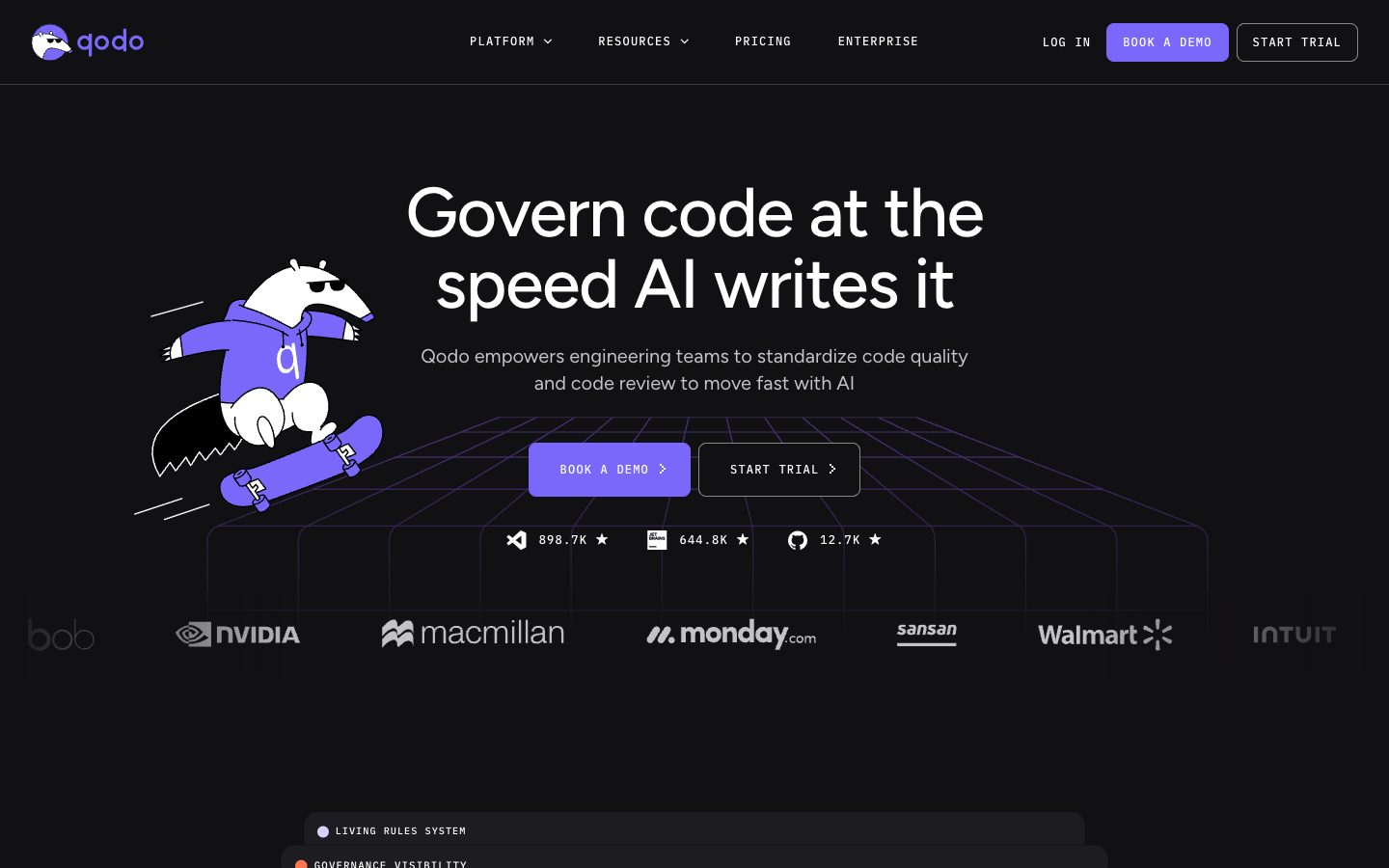
Qodo is an AI code review and code-quality platform for engineering teams. It reviews pull requests with repository context, applies shared rules, and exposes findings and quality history across repositories. Qodo’s current platform is centered on review and governance; its April 2026 product update says the former IDE code-generation and autocomplete features are being deprecated, while pre-PR review remains supported in the IDE.
✨ Key Features
- Context-aware pull-request review — Analyze changes in Git workflows and surface bugs, logic gaps, dependency conflicts, and other review findings before merge.
- Cross-repository context — Connect related repositories so reviews can reason about relationships beyond a single diff.
- Agentic issue finding — Use multiple review agents to return focused, actionable findings instead of a generic summary.
- Rules system — Define and enforce organization-specific coding standards in one place, with no stated rule-count limit on the Pro Team plan.
- Pre-PR IDE review — Review local changes while coding, before opening a pull request, through the supported IDE integrations.
- Git-provider integrations — Connect GitHub, GitLab, Bitbucket, and Azure DevOps; Gerrit support is listed for Enterprise.
- IDE integrations — Use Qodo with VS Code and JetBrains IDEs, including IntelliJ IDEA, PyCharm, WebStorm, GoLand, CLion, RubyMine, and PhpStorm.
- Findings and quality history — Use dashboards and analytics to track findings, resolution rates, open issues, and repository risk.
- Deployment and governance controls — Enterprise adds SSO/SAML, audit logs, BYOK, single-tenant SaaS, on-premises or air-gapped deployment, and priority support.
- Data-use boundary — Qodo states that it does not train models on customer code; teams should still review retention and deployment settings for their plan.
💳 Pricing
- 14-day trial — Free trial with unlimited reviews and credits; no credit card is required. Reviews pause when the trial ends until a paid plan is selected.
- Pro Team — Starts at $30/month for a credit pack of 2,500 credits (about 18 reviews/month on the pricing page). Additional displayed packs include $60/month for 5,000 credits (about 36 reviews) and $240/month for 20,000 credits (about 144 reviews). The plan is designed for up to 30 users, uses pooled credits, supports monthly billing, and allows a customer-set overage cap.
- Enterprise — Custom pricing for larger teams. Adds SSO/SAML, audit logs, governance analytics, advanced self-learning, BYOK, Gerrit, single-tenant SaaS or on-premises deployment, priority support, and a dedicated customer success manager.
- Open Source program — Qualified open-source projects can apply for free access; this is an eligibility program rather than a general permanent free tier.
Pricing note — The current FAQ explicitly states there is no permanent free tier; general access is a fourteen-day trial followed by a paid plan. Qualified open-source access is separate. Credits are the unit used to meter reviews, expire at the end of each monthly cycle, and overage is charged at the same per-credit rate until the customer-set cap. Qodo says paid plans do not train models on customer code.
⚖️ Alternatives Compared
| Product | Best for | Public pricing | Key difference |
|---|---|---|---|
| Qodo | PR review and code-quality governance | Paid plans from US$30/mo; 14-day trial; qualified open-source program separate | Combines context-aware review, rules, findings history, and deployment controls |
| Aider | Terminal-based AI pair programming | See official pricing | Focuses on an interactive coding workflow in a local repository |
| Amazon Q Developer | AWS-aware developer assistance | See official pricing | Connects coding assistance with AWS development workflows |
| Augment Code | Context-rich AI coding | See official pricing | Emphasizes codebase context during software development |
🎯 Use Cases
- Engineering teams:Review pull requests for defects and standards violations before merge.
- Platform teams:Publish shared rules and monitor whether repositories follow them.
- Multi-repository organizations:Investigate changes whose impact crosses service or repository boundaries.
- Individual developers:Run a pre-PR review inside a supported IDE while changes are still local.
- Security and compliance reviewers:Use audit logs, findings history, and governance analytics on Enterprise.
- Self-hosting teams:Deploy Qodo on-premises or in an air-gapped environment when the Enterprise plan supports that requirement.
Qodo Website Overview
Qodo has an Ahrefs Domain Rating of 76 and falls within Cloudflare Radar's global top 200,000 popularity bucket. This bucket is unordered, and neither signal represents actual visits.
- Domain rating
- 76
- Popularity position
- Top 200,000
- Primary category
- Unavailable
- Ranked locations
- 0
Ahrefs
Cloudflare Radar
Cloudflare Radar
Cloudflare Radar
Website categories
No category data is available yet.
Top locations by rank
No location ranking is available yet.
Data coverage
Free popularity and domain-authority signals only; no estimated visits or engagement metrics are shown.
Sources: Domain Rating by Ahrefs · Cloudflare Radar · Oct 19, 2026. Cloudflare Radar data is licensed under CC BY-NC 4.0.
Similar tools
Tabnine
PaidPrivate, governed AI code assistance and agentic development for teams
Sourcegraph Cody
PaidEnterprise AI coding assistant using code search and repository context
Augment Code
PaidContext-aware coding agents for large and complex codebases
JetBrains AI Assistant
FreemiumJetBrains AI Assistant brings AI chat, code completion, generation, explanation, and refactoring into JetBrains IDEs. It helps developers work with code an
GitHub Copilot
FreemiumAI coding assistance, agents, code review, and CLI workflows across GitHub and your editor